
�Australia's original inhabitants, known as Australian Aborigines, have the longest continuous cultural history in the world, with origins dating back to the last Ice age. Although mystery and debate shroud many aspects of Australian prehistory, it is generally accepted that the first humans travelled across the sea from Indonesia about 70,000 years ago. The first visitors, called 'Robust' by archaeologists because of their heavy-boned physique, were followed 20,000 years later by the more slender 'Gracile' people, the ancestors of Australian Aborigines.
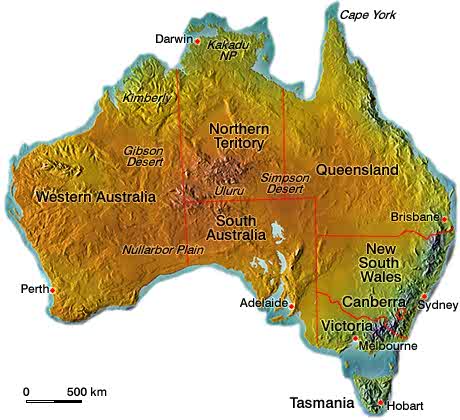
�Europeans began to encroach on Australia in the 16th century: Portuguese navigators were followed by Dutch explorers and the enterprising English pirate William Dampier. Captain James Cook sailed the entire length of the eastern coast in 1770, stopping at Botany Bay on the way. After rounding Cape York, he claimed the continent for the British and named it New South Wales.
�In 1779, Joseph Banks (a naturalist on Cook's voyage) suggested that Britain could solve overcrowding problems in its prisons by transporting convicts to New South Wales. In 1787, the First Fleet set sail for Botany Bay under the command of Captain Arthur Philip, who was to become the colony's first governor. The fleet comprised 11 ships, 750 male and female convicts, four companies of marines and supplies for two years. Philip arrived in Botany Bay on 26 January 1788, but soon moved north to Sydney Cove, where there was better land and water. For the new arrivals, New South Wales was a harsh and horrible place, and the threat of starvation hung over the colony for at least 16 years.
�Free settlers began to be attracted to Australia over the next decades, but it was the discovery of gold in the 1850s that changed the face of the colony. The huge influx of migrants and several large finds boosted the economy and irrevocably changed the colonial social structures. Aborigines were ruthlessly pushed off their tribal lands as new settlers took up land for farming or mining. The Industrial Revolution in England required plenty of raw materials, and Australia's agricultural and mineral resources expanded to meet the demand.
�Australia became a nation when federation of the separate colonies took place on 1 January 1901 (although many of the legal and cultural ties with England remained). Australian troops fought alongside the British in the Boer War, WW I and WW II. However, the USA's role in protecting Australia from Japanese invasion during WW II marked the beginning of a shift in allegiance. Australia subsequently followed the USA into both the Korean and Vietnam wars in Asia.
�Post WW II immigration brought a flood of European immigrants, many of them non-British. The immigrants have since made an enormous contribution to the country, enlivening its culture and broadening its vision. In the 1980s, Australia accepted large numbers of Asian refugees, especially from Vietnam. Socially and economically, Australia is still trying to come to terms with its place in Asia. Issues of the day include republicanism, universal acceptance of the Native Title Act passed in 1993 and the alarming rise of a racist right-wing party called One Nation. Unfortunately, many Aborigines continue to live in deplorable conditions